

Dear 20 Percent,
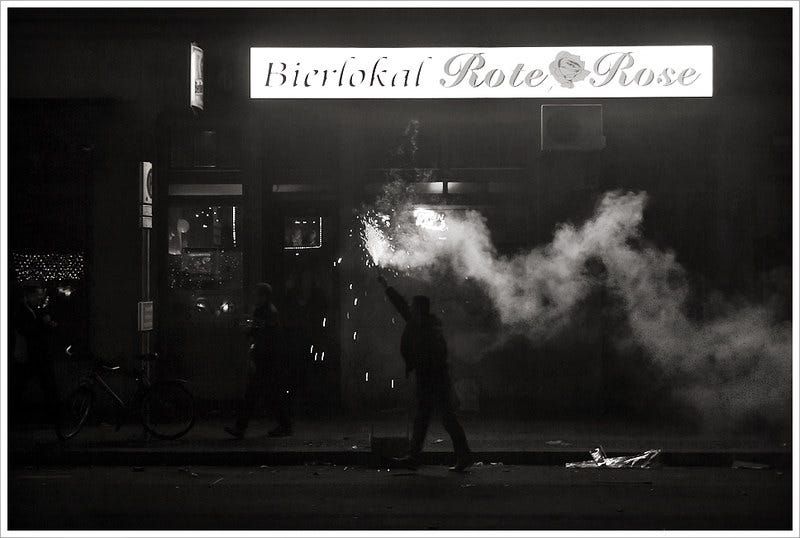
Tomorrow’s New Year’s Eve. Pyro-crazy Berliners — a minority of the population — re-enact the war for a night, with grave consequences for safety and the environment.
Another Silvester is here and Germany has again failed to do anything to crack down on out-of-control fireworks. So much for Ordnung muss sein.
Four areas — Alexanderplatz, Hermannplatz/Sonnenallee, Steinmetzkiez in Schöneberg and now Kreuzberg’s Admiralsbürcke — are supposed to be pyrotechnic-free zones. Good luck enforcing that.
About 4,600 cops will be on the streets but they won’t be able to prevent a repeat of last year, when 360 people were seriously injured. There’ll probably be bottle rocket attacks on first responders and plenty of pointless injuries, tonnes of toxic trash, noxious gunpowder smog, noise pollution — and terrified animals. Emergency rooms will be filled with burn cases and people with damaged eyes.
The federal government is considering legislation that could allow local communities to ban private fireworks in densely populated areas — the classic German piecemeal approach. In theory this means fireworks could be banned within the Ringbahn by this time next year, as my colleague Josh explains in the latest edition of my other newsletter, Update Germany.
This year, we’ll have to stick it out one more time. Hope your Rutsch is gut — and injury-free.
Below, my top five stories for the year.
Before, Andrew and I would like to thank you, dear 20% Berlin readers, for your continued support for our newsletter and podcast. We’d be nothing without you. We’ll be doing more events to build our IRL community next year. The third 20% Berlin News Quiz on January 14, for example. It’s free but please RSVP.
See you in 2026.
Maurice
PS: The latest episode of the 20% Berlin Podcast just dropped — we discuss it all and I spill beer on Andrew’s sofa.
My 5 Berlin stories of the year — in no particular order.
Thanks to a bit more digitalisation and more staff at the Landesamt für Einwanderung (LEA), the state of Berlin is set to create a record 40,000 new Germans in 2025. A record 27,500 citizenship applications had been successfully processed by the end of October. There’s still a massive backlog, though, and around 1,800 people are suing the LEA for processing their visa or citizenship applications too slowly. 2025 was also the year that my co-writer Andrew filed his application to become German. He’s also looking forward to suing in 2026.
Seems like forever ago, but last winter/spring, Berlin had to endure repeated strikes by sanitation workers (BSR) and public transport workers (BVG, DB), as well as kindergarten, hospital and swimming pool staff. As Andrew puts it, we were like France for a while.
Crack cocaine abuse exploded on Berlin’s streets in 2025, thanks to a flood of regular cocaine entering Europe, meaning falling prices. The ultra-addictive, ultra-dangerous version of coke cooked with baking soda has spread rapidly across Berlin and every other big city in the country. The crack scene appears to have crystralized around Leopoldplatz in Wedding, parts of Neukölln and Wrangelkiez in Kreuzberg. Many of its users are homeless — crack addiction can bring with it next-level destitution. Social services are struggling to keep up.
Housing, housing, housing. Just finding a roof over one’s head remains a huge challenge for many Berliners or wannabe Berliners. Homelessness is up. Although average rental prices stagnated at just over €15/m² “warm” , we’re now the fourth most expensive city in the country for renting, behind Munich, Hamburg and Stuttgart. Just 14,000 new apartments were built in 2025, far below the government’s target of 20,000 — the lowest level of residential construction since 2013. Debate continues to rage over whether to build housing on the edge of Tempelhofer Feld. Mayor Kai Wegner is hellbent on doing so. And the government is delaying coming up with a plan to buy back 220,000 privatised units, which the successful citizen’s referendum of 2021 instructed it to do. Berlin is taking baby steps to help tenants find out if their rent’s too high with its new but understaffed Mietprüfstelle, as is the rent check app published by leftwing party, Die Linke, which can give you an idea of whether you’re paying illegally high rent or not. If so, probably time to lawyer up. I’ve seen evidence in the press and heard anecdotal evidence from friends that tenants are having success getting their rent reduced. Any way, the problem isn’t limited to Berlin — and it’s complicated. If you ask me, the state needs to balance regulation that protects renters with incentives such as reducing paperwork and fast-tracking building permits to get enough affordable housing built.
Ending on a bright note, Berlin outperformed other parts of Germany this year! The city-state’s economy is set to grow by a whopping 1% this year, outperforming flatlining Germany. 1.8% is expected for Berlin next year, thanks to increases in spending on transport and digital infrastructure. Retail, construction, and pharma are doing well — while tourism is shrinking slightly. Berlin is far less dependent on Germany’s struggling car industry — where tens of thousands of jobs have been shed this year. Those losses are mostly in places like Baden-Würtemberg, home of Porsche and Mercedes-Benz, and a place that generally is considered to have its sh*t together compared to Berlin. The capital is more focused on software and services — so it’s doing comparatively well. Let’s not get too cocky, though. Berlin’s unemployment rate (10%) is still twice that of Baden-Württemberg’s (4.9%).
Arson on Kältebussen
An unknown assailant set one of two Kältebus buses alight late Sunday, taking it as well as the other bus, which are used to bring homeless people to shelters on cold nights, out of service, according to Tagesspiegel. The buses last year brought 2,100 people to safety. The buses have been in service for 31 years and were sponsored by the Deutsche Bahn Foundation, which quickly donated another €70,000 so the church-backed charity behind the buses could finance two new vehicles. The cops are investigating the arson.
War zone Berlin
Berlin will have 2,100 firemen on duty on New Years, including 1,600 professional firefighters and 500 volunteers, according to Tagesspiegel. Meanwhile 4,600 cops will be on duty, compared to about 1,000 on most nights, to deal with the general choas. They’ve already been adding several hundred extra cops each night since fireworks went on sale Dec. 28.
🍺 🥨 Germany-wide news 🥨 🍺
😑 AfD invited to Munich Security Conference for the first time
😑 Berlin denounces US sanctions against German anti-hate speech group
😑 Why Germany struggles to go digital
Factoid

Top 5 baby names Berlin and Brandenburg this year (they only do them combined)!
Mädchen:
Hannah
Emilia
Clara
Sophia
Emma
Jungen:
Noah
Matteo
Liam
Leon
Emil
🔗 🔗 🔗 Useful links 🔗 🔗 🔗
🎙️The 20% Berlin Podcast on Spotify
Happy new year you guys! And thanks for this service (which I think I still pay for on Patron...) Do you have a suggestion box for potential advertisers you can approach? I know two local businesses that are kind of hurting for business and they both might appeal to expats: a liberal, pacifist, cross-religion Israeli restaurant https://maps.app.goo.gl/QPGk6cGHqoo3KPSJA and a whiskey store surprisingly well stocked in Scottish and Japanese https://maps.app.goo.gl/RVF86MLBDm2iqo4B8 though that second one is weirdly lacking with English. But if you call in you might easily be able to sell a week or two of ads.